A walk into any student support center carries the aroma of lingering, burnt coffee, as well as anxious excitement. This could be a place of solutions for some students, but for undocumented students, these same centers can feel like high-stakes interrogation chambers. Every query regarding a tuition waiver or a state-specific grant is laced with an elephant in the room: How safe will it be for me to inquire? Will my status be flagged?
In today’s higher education environment, access is not only about filling a seat in a classroom; it is about having the knowledge to attend without fear. This is where the technological shift has the ability to be a social justice mechanism. Through the incorporation of an audio translator, the university has the ability to connect the dots between “we are here to help” and “you are safe to seek help.”
Read on to know how higher ed student support offices can utilize this technology to enhance access for undocumented students like yourself or someone you know.
In This Article:
Removing the Fear of the Desk
One of the largest barriers for undocumented students is the physical or official gatekeeper at the front desk. Even the most caring employee represents the institution, and for individuals who are defined by illegality in their lives, anonymity is a strategy for survival.
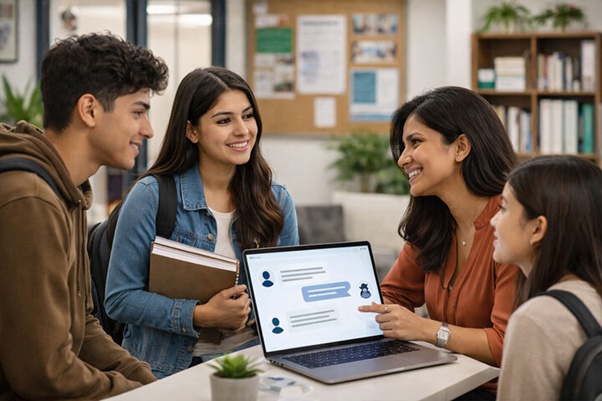
Conversational AI provides a digital buffer. This enables the student to pose the question: Can DACA students get in-state tuition in my state of residency? in the privacy of their dorm room at 2:00 AM. There is no facial expression to interpret, no possibility of microaggression is obviated, and again, there is never any paperwork to be linked with the nervous delivery of the voice. Research suggests that marginalized students often feel more comfortable asking basic or sensitive questions to an AIbecause the fear of judgment is removed. It turns the support center into a resource that is always open and never judgmental.
Navigating the Maze of “Yes, But…”
If you’ve ever looked at financial aid policies for non-citizens, you know they are a dizzying maze of “Yes, but…”
For example, you may come across situations like these:
- Yes, you are eligible to apply for this scholarship award, provided, of course, that you have an ITIN.
- Yes, the state can be relied upon to offer scholarships; however, the federal FAFSA is not available.
Whenever policy shifts occur, and this happens quite often in today’s political atmosphere, the actual personnel are not able to adjust to the change. But an AI assistant can be updated in just a few minutes.
Rather than a student being referred from the Financial Aid office to the Registrar and back, simply to be told “I’m not sure, let me check with my supervisor,” a well-trained chatbot can instantly and accurately offer a glimpse into what a student actually qualifies for. It’s about more than just streamlining a process; it’s about keeping a student from going through the kind of runaround arrangements that result in undocumented students abandoning their applications altogether.
Multilingual Support Without the Wait
Access isn’t just an issue of legal status; it’s an issue of language. In fact, undocumented students from families whose primary language isn’t English play a significant role in navigating the system for their families. When a parent wants to decipher a tuition statement or a housing contract, it’s their child who ends up deciphering it.
This is where the human impact of a high-quality audio translator becomes a game-changer. These tools can turn instantly from English to Spanish, Tagalog, or Mandarin, making it possible for families to hear and communicate with the university in the language they speak at home.
By providing real-time voice translation, support centers break the English-only barrier that makes higher education feel like an exclusive club rather than a community. It allows a mother or father to participate in their child’s education without needing their child to act as a linguistic filter for every document.
Scaling Personalized Care
Support center personnel are frequently overwhelmed. When 500 students ask the same question about a deadline, the quality of the 501st answer naturally dips. When we, by means of AI, automate routine questions, we effectively humanize the office.
In allowing the technology to respond to the “How do I find my 1098-T?” or “Where is the location of the Undocu-Resource center?”, the employees are able to focus on the more personal and complicated cases that are brought to them, and that can never be fully addressed by the AI or any computer program. This enables the support center to transition from a reactive answering service to a proactive advocacy center.
Safeguarding Identity Through Data Privacy
There is concern about how AI might put students at risk by collecting data. But it is possible to build privacy-first protocols directly into an audio translator.
A university can establish a system that will supply data without needing either a login or a student ID for general information.
What a huge difference it makes for undocumented students to know that they might be able to get a hard answer on a “Safe Zone” policy without ever having to enter their name or a permanent voice recording. This establishes a “know-your-rights” database that is interactive and accessible.
Conclusion: A New Chapter for Support
Access will become a dynamic conversation, rather than simply a webpage policy, as universities embrace advanced voice technology. It is important to note that these digital technologies are not replacing humans but expanding the reach of their humanity by making sure that no student, regardless of their paperwork, feels like they are walking the path alone.
How is your campus currently handling these invisible barriers? Let us know in the comments.